
Drawing is a kind of communication, much like speaking and writing. Drawing can express a wide range of concepts, viewpoints, and observations, much like these other means of expression. Artists and designers use drawing as a specialised tool for visual communication in the broad field of art and design. Regardless of their goals, they also use various sketching techniques to communicate, develop, and present their ideas and creations to the audience.
Therefore, it is impossible to create a drawing without a clear understanding of the type of drawing needed and the visual language that will be used to give the drawing shape and expressive vitality.

EARLY EXPERIENCES WITH DRAWING
When we first begin drawing, we typically want to capture whatever we see, whether it be a still life, a landscape, or a portrait. As we age, we would rather make our conclusions based on direct observation than on memory, as children do. This is frequently when we begin to struggle with sketching because we have a deep-rooted belief that our depiction of what we see must be perfect in order for us to be skilled at this art form.
Students who take this approach—those who appear to be utilising their medium to seek a visual truth—often feel frustrated and failed. Reality is unrepeatable; all we can do is produce a mark or statement that acts as a substitute for it or that best serves the purpose of explaining it. This form of symbol or phrase is known as a metaphor.
Rather than pursuing the concept of reality, we should embrace the medium of drawing and apply it to attain a purpose that meets our needs as designers or artists. Now, let me explain how we might break down our understanding and use drawings to help us reach our goals. As I’ve previously stated, there are numerous reasons why we would desire to draw, as well as various approaches and mindsets we could use to attain our goals in the medium of our choice.
The following is a list of reasons why we draw as students or novices.
When using this book, you should first identify why you want or need to create the type of picture you are going to make, and then open the appropriate chapter. You will then have the medium-specific skill and expertise needed to complete the drawing.
PURPOSE OF DRAWING
1. Initial Thoughts
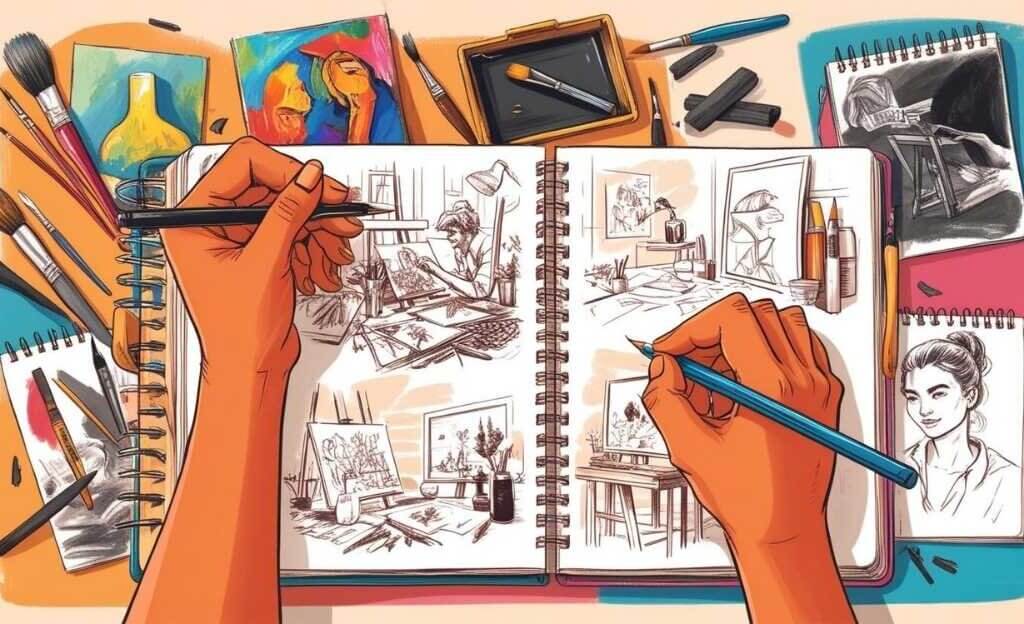
Using sketching to capture our early thoughts is just one of various approaches to the art form. Typically, these take the form of fast sketches and doodles. Drawing one’s thought process as it occurs usually leads to something spontaneous and inspiring. This strategy has the potential to generate novel ideas. This procedure, which is typically conducted in sketchbooks or on scrap paper, yields sheets of presented ideas.
Many artists from various disciplines, including Michelangelo, Raphael, Leonardo da Vinci, Rembrandt, and the artists of Disney films up to the present, have used drawings to work and think through their original concepts. These sketches are then saved and transformed into something more substantial as a statement when our ideas for the topic are gathered and refined later on.

2. Information gathering and research
Artists and designers use drawing research to gather information on a certain job or subject on which they have decided to work for aesthetic reasons or have been commissioned to do so.
Typically, research is conducted in sketchbooks and on sites that provide important data. These places could be in the studio, outdoors, libraries, galleries, or museums. Everything depends on the type of research required for the specific project. An artist’s research can generate a wide range of information, including shape, form, texture, diagrammatic understanding, techniques, fact documentation, and more. Typically, this type of employment is completed by taking notes and sketching.
As a visual resource, artists, like researchers, acquire information on a continuous basis. It is a visual vocabulary that can be consulted whenever necessary, and visual information of this nature should be consistently gathered and kept for use by artists. Because information collection includes anything that the artist deems visually appealing, it covers a broader spectrum of subjects than study.
Looking at some of Leonardo da Vinci’s sketches reveals how inquisitive the artist was, constantly collecting information from science and nature. Information collection is an excellent illustration of a curious mind that is always interested in the observable world.
3. Diagrammatic Illustrations
These illustrations are often used to provide instructions. Consider a map, for example. If someone asks for directions, we usually sketch them a crude map so they can figure out where they’re going. Diagrammatic drawings have also been used in numerous civilisations to help us interpret and understand the elements of that culture, as well as its religious or philosophical implications. Basic diagrammatic drawings are given with self-assembly items such as models, furniture, and machines!
4. Conceptual Illustrations
Theoretical drawings are important in art history because they allow us to understand space and proportion by employing theoretical and analytical techniques. These drawings, which comprise perspective, planometric, isometric, trimetric, and proportion and measurement drawing approaches, are commonly known as projection systems. This theoretical drawing basis underpins architectural designs, nature-inspired drawings, and human proportions alike.
5. Copies
Copying is the process of observing how other artists have used the drawing medium. The book’s subsequent chapters make extensive use of copying. It simplifies and enhances our understanding of the drawing process. It allows us to study and grasp the language of drawing more thoroughly.
6. Using Nature as Inspiration
Nature inspires all artists, whether it’s an exact recreation or a painting based on memory. Nature-inspired drawings include images of still life, the human form, and the surrounding environment or landscape. Realising this necessitates a clear understanding of our drawing aims, method of approach, and language or technique to be used in its creation—all of which are required when making a natural illustration.
This is something that novices and students frequently overlook, and not having this knowledge is analogous to embarking on a journey without knowing where you’re headed. When sketching from nature, we should aim to find drawing methods that visually correspond to the topic we have chosen to illustrate. In the following chapters of the book, I’ll discuss a number of strategies and ideas for creating nature drawings. Throughout history, artists have continually included natural aspects in their work, particularly as a means of gathering and preserving visual knowledge for future use.
7. Presentation Illustrations
This is most popularly known as the Modello in Italian. These drawings are frequently commissioned works of art or those created for a patron.
Another term for them is “artist’s impressions.” Their purpose is to give the client a preview of the finished result. Before beginning the principal piece of work, the patron and artist may reach an agreement. These are intended to prevent mistakes from occurring, generally at a high expense to the patron or artist.
8. Calligraphy Illustrations
The artist employs a range of markings in calligraphic drawings to function as indicators or emblems of cultural values. As students or beginners in the art of drawing, we should create a list of symbols for the various media that allow us to express our thoughts, observations, and emotions. It’s a wonderful idea to experiment with different markings, lines, forms, tones, and textures.
Do not underestimate this aspect of the drawing process; these types of experimentation with different media are seen throughout the book’s chapters and are an important part of our learning experience when we first start drawing. Calligraphy evolved as a result of strict cultural rules, with Persian and Chinese calligraphy serving as the first known examples. To create a drawing in ancient civilisations, one had to understand and follow strict rules and traditions.
9. Drawing independently
Drawings done for aesthetic purposes are considered their own entity. Conversely, illustrations fall under this category because they can complement or operate independently of text. Drawings enhance the reading experience by adding a visual aspect to complement the content.
This piece uniquely provides analytical, emotive, and skill-based approaches to drawing for beginners and students. Following that, these methodologies and strategies are linked to appropriate platforms for implementation. However, the ideas in the book should only be used as a starting point for your drawing efforts.
It’s important to approach your ideas and innovations with enthusiasm and passion. A true artist must challenge norms, methods, and ideas.




You have a real gift for explaining things.
This gave me a whole new perspective. Thanks for opening my eyes.
Thank you for offering such practical guidance.
I love how well-organized and detailed this post is.
Your content always adds value to my day.
This was so insightful. I took notes while reading!
Your writing always inspires me to learn more.
It’s great to see someone explain this so clearly.
This is one of the best explanations I’ve read on this topic.
This was easy to follow, even for someone new like me.
I appreciate the depth and clarity of this post.
This content is really helpful, especially for beginners like me.
You have a real gift for explaining things.
I learned something new today. Appreciate your work!
This was so insightful. I took notes while reading!
I’ve gained a much better understanding thanks to this post.
This is now one of my favorite blog posts on this subject.
This content is gold. Thank you so much!
You clearly know your stuff. Great job on this article.
I hadn’t considered this angle before. It’s refreshing!
Thank you for offering such practical guidance.
This was incredibly useful and well written.
I never thought about it that way before. Great insight!
I’ve bookmarked this post for future reference. Thanks again!
What I really liked is how easy this was to follow. Even for someone who’s not super tech-savvy, it made perfect sense.
What a helpful and well-structured post. Thanks a lot!
Keep educating and inspiring others with posts like this.
This topic really needed to be talked about. Thank you.
Thank you for making this topic less intimidating.
I always look forward to your posts. Keep it coming!
I enjoyed every paragraph. Thank you for this.
You really know how to connect with your readers.
I learned something new today. Appreciate your work!
I always look forward to your posts. Keep it coming!
You made some excellent points here. Well done!
I really appreciate content like this—it’s clear, informative, and actually helpful. Definitely worth reading!
I’ll be sharing this with a few friends.
This helped clarify a lot of questions I had.
Posts like this are why I keep coming back. It’s rare to find content that’s simple, practical, and not full of fluff.
This gave me a whole new perspective on something I thought I already understood. Great explanation and flow!
This content is really helpful, especially for beginners like me.
I enjoyed every paragraph. Thank you for this.
This content is really helpful, especially for beginners like me.
Thank you for sharing this! I really enjoyed reading your perspective.
I learned something new today. Appreciate your work!
I feel more confident tackling this now, thanks to you.
I wasn’t sure what to expect at first, but this turned out to be surprisingly useful. Thanks for taking the time to put this together.
I wasn’t expecting to learn so much from this post!
I really needed this today. Thank you for writing it.
Your content never disappoints. Keep up the great work!
I appreciate the depth and clarity of this post.
What a helpful and well-structured post. Thanks a lot!
I really appreciate content like this—it’s clear, informative, and actually helpful. Definitely worth reading!
Thanks for sharing your knowledge. This added a lot of value to my day.
This was incredibly useful and well written.
Thanks for addressing this topic—it’s so important.
I agree with your point of view and found this very insightful.
It’s refreshing to find something that feels honest and genuinely useful. Thanks for sharing your knowledge in such a clear way.
I appreciate the real-life examples you added. They made it relatable.
You made some excellent points here. Well done!
Your passion for the topic really shines through.
I’ll definitely come back and read more of your content.
This was really well done. I can tell a lot of thought went into making it clear and user-friendly. Keep up the good work!
I love how well-organized and detailed this post is.
This is now one of my favorite blog posts on this subject.
Great points, well supported by facts and logic.
The way you write feels personal and authentic.
I’ve gained a much better understanding thanks to this post.
I love how well-organized and detailed this post is.
Very useful tips! I’m excited to implement them soon.
I feel more confident tackling this now, thanks to you.
Thank you for sharing this! I really enjoyed reading your perspective.
This post gave me a new perspective I hadn’t considered.
This made me rethink some of my assumptions. Really valuable post.
So simple, yet so impactful. Well written!
Your writing style makes complex ideas so easy to digest.
Excellent work! Looking forward to future posts.
I’ve gained a much better understanding thanks to this post.
You have a real gift for explaining things.
Great article! I’ll definitely come back for more posts like this.
Keep writing! Your content is always so helpful.
Such a simple yet powerful message. Thanks for this.
Your passion for the topic really shines through.
This content is gold. Thank you so much!
You’ve clearly done your research, and it shows.
You’ve built a lot of trust through your consistency.
This content is gold. Thank you so much!
Such a thoughtful and well-researched piece. Thank you.
You write with so much clarity and confidence. Impressive!
You write with so much clarity and confidence. Impressive!
Your advice is exactly what I needed right now.
I enjoyed every paragraph. Thank you for this.
Posts like this are why I keep coming back. It’s rare to find content that’s simple, practical, and not full of fluff.
I’ve read similar posts, but yours stood out for its clarity.
This topic is usually confusing, but you made it simple to understand.
Such a thoughtful and well-researched piece. Thank you.
I love the clarity in your writing.